
Reading Time: 4 minutes
Why Accountability Fails in Most Organizations
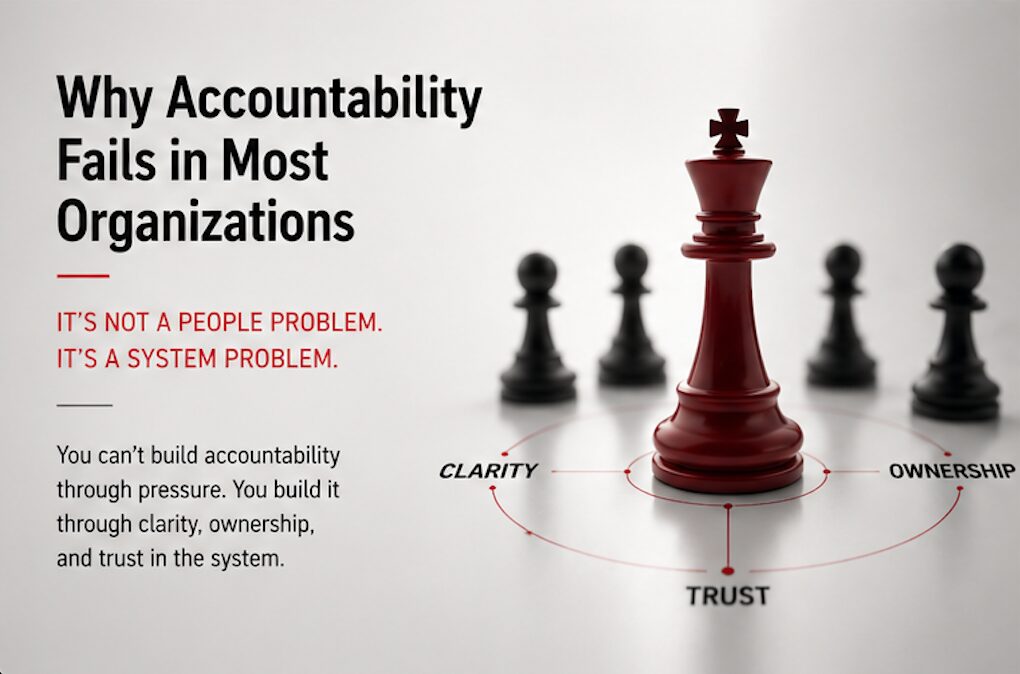
Accountability in organizations often fails not because people lack discipline, but because the trust environment does not support ownership. When trust is weak, people avoid responsibility, delay action, or shift blame. True accountability is not enforced through pressure. It is built through a system where ownership is clear, supported, and safe to carry.
The Common Assumption About Accountability
In many organizations, accountability is treated as a discipline issue.
When results fall short, the response is predictable. Leaders call for more ownership. Expectations are restated. Deadlines are tightened. Performance conversations become firmer.
On the surface, this approach makes sense.
If people are not delivering, they should be held accountable.
But over time, something becomes clear. Even with increased pressure, the same patterns continue. Work is delayed. Ownership is unclear. Responsibility shifts instead of settles.
This is where most organizations misdiagnose the problem.
Accountability Is Not About Pressure
Pressure can force short-term compliance, but it does not create real accountability.
In fact, in many cases, it does the opposite.
When people feel pressure without support, they protect themselves. They become cautious. They avoid taking ownership of outcomes that may carry risk. Instead of stepping forward, they step back.
This is not a failure of character. It is a rational response to the environment.
Accountability in organizations does not fail because people do not care. It fails because the system makes ownership feel risky.
What Accountability Actually Requires
For accountability to work, three conditions must exist.
First, ownership must be clear. People need to know what they are responsible for, not just in theory, but in practice. When ownership is ambiguous, responsibility spreads across the group, and no one fully commits.
Second, authority must be real. People cannot be accountable for outcomes if they do not have the authority to act. When authority exists on paper but not in reality, accountability becomes performative.
Third, support must be consistent. When people take ownership, they need to know they will be backed, especially when outcomes are uncertain.
Without these conditions, accountability becomes fragile.
Why Accountability Breaks Down
In most organizations, accountability does not fail loudly. It fails quietly.
People attend meetings, agree on actions, and signal commitment. But when it is time to act, hesitation appears. Follow-through weakens. Deadlines slip.
This pattern is closely connected to how decisions behave in the organization—something I explored earlier in Why Your Team Keeps Circling the Same Decision.
When decisions do not hold, accountability cannot hold either.
The Role of Trust in Accountability
At its core, accountability is a trust problem.
People need to trust that:
- Their ownership is real
- Their authority will be respected
- Their decisions will be supported
When this trust exists, accountability becomes natural. People step forward, take ownership, and follow through.
When it does not, behaviour changes. People delay decisions, seek excessive validation, or shift responsibility.
This is the same pattern seen in execution breakdowns across organizations—something I explored in Why Work Doesn’t Get Done (Even When Everyone Agrees).
What Low-Trust Accountability Looks Like
In low-trust environments, accountability becomes distorted.
Leaders spend more time chasing updates than driving outcomes. Teams appear busy but struggle to deliver consistently. Conversations about accountability become frequent, but results do not improve.
Over time, a culture forms where:
- Ownership is avoided
- Blame is distributed
- Progress slows
This is not because people lack capability. It is because the system does not support accountability.
What High-Trust Accountability Looks Like
In high-trust organizations, accountability feels different.
Ownership is clear and accepted. People act without needing constant follow-up. Progress is visible, and outcomes are owned without defensiveness.
This is not because people are more disciplined.
It is because the environment supports ownership.
People trust that acting within their role is safe. They trust that they will be supported. And they trust that being wrong will not be punished unfairly.
As a result, accountability becomes part of how work flows.
The Shift Leaders Need to Make
When accountability fails, the instinct is to increase pressure.
But pressure does not fix the problem.
The better question is simpler: Why does ownership feel risky in this organization?
When leaders ask this question honestly, they begin to see the real constraints. They see where authority is unclear, where support is inconsistent, and where trust is weak.
Fix those conditions, and accountability improves naturally.
The Bottom Line
Accountability in organizations does not fail because people lack discipline.
It fails because the system does not support ownership.
When trust is strong, accountability follows. When trust is weak, pressure replaces it, and performance suffers.
If you want real accountability, don’t start with enforcement.
Start with trust.
About the Trust Operating System™
Trust Operating System™ (Trust OS™) is a proprietary framework for diagnosing and strengthening trust within organizations. It helps leaders remove friction, accelerate decision-making, and improve execution without adding unnecessary complexity.
Rather than focusing solely on how people feel, it focuses on how work moves—and fixes what slows it down. To learn more about implementing the Trust Operating System™ in your organization, visit nkemmpamah.com or connect with me on LinkedIn.