
Reading Time: 4 minutes
Why Work Doesn’t Get Done (Even When Everyone Agrees)
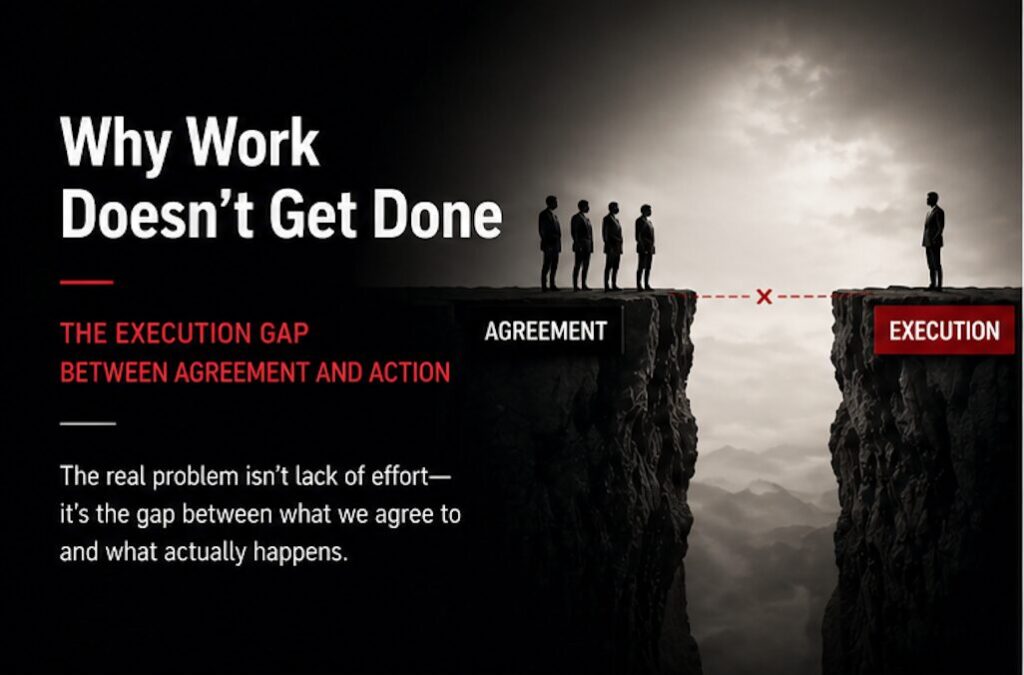
Execution in organizations breaks down when agreement does not lead to action. Many teams align in meetings, yet work still doesn’t move forward. This gap is rarely caused by poor strategy. It is usually the result of weak organizational trust, where decisions are not translated into consistent execution.
Agreement Is Not the Same as Execution
In many organizations, agreement is treated as progress. A meeting ends, everyone nods, and there is a shared sense that clarity has been achieved. From the outside, it looks like alignment. From the inside, it feels like things should now move.
But then nothing happens.
Follow-ups are needed. Reminders are sent. Deadlines pass without urgency. The same conversation returns, often with growing frustration.
This is where execution in organizations quietly breaks down. Leaders assume that once people agree, action will follow. In reality, agreement is only the starting point. Execution requires something more.
Where Execution Actually Breaks Down
The gap between agreement and action is where most execution problems live.
After decisions are made, ownership is often unclear in practice, even if it seemed clear in the moment. People leave the room with slightly different interpretations of what was agreed. Priorities compete, and attention shifts quickly to other demands.
In some cases, the issue is not confusion but hesitation. People understand what needs to be done, yet they delay. They wait for confirmation, check with others, or avoid moving too quickly.
This is not random behaviour. It reflects a deeper pattern in how decisions function after they are made—something I explored earlier in Why Your Team Keeps Circling the Same Decision.
Execution Depends on Trust, Not Just Clarity
Clarity is important, but it does not guarantee execution.
Execution in organizations depends on trust.
People need to trust that decisions will hold after they are made. They need to trust that ownership is real and that acting within it will be supported. They also need to trust that if something goes wrong, the response will be constructive rather than punitive.
When this trust is missing, behaviour changes. People slow down. They double-check. They seek additional validation before acting.
This is why capable people often hesitate even when expectations are clear—patterns I explore in The Permission Trap: Why Your Best People Are Waiting Instead of Moving.
Why Work Feels Heavier Than It Should
When execution in organizations is weak, work begins to feel heavier than necessary.
Tasks require repeated follow-up. Decisions require reinforcement before action begins. Leaders spend time checking progress instead of driving it.
From the outside, this can look like a performance issue. It may seem that people are not taking ownership or not working hard enough. But in most cases, the issue is not effort.
It is friction.
That friction shows up as uncertainty about authority, inconsistent support, and hesitation about moving forward. Over time, these small frictions compound, slowing execution across the organization.
This is what happens when trust is not functioning as infrastructure—something I explore in Trust Infrastructure: The Hidden Problem Slowing Your Team.
The Cost of Weak Execution
When execution breaks down, the cost is rarely immediate, but it is significant.
Projects take longer than expected. Teams lose confidence in their ability to deliver. Leaders spend more time managing delays than driving outcomes. Opportunities narrow as the organization moves more slowly than its environment.
Over time, a gap emerges between what the organization is capable of and what it actually produces.
This is the hidden cost of poor execution in organizations. It is not always visible in the moment, but it compounds over time.
What High-Execution Organizations Do Differently
In organizations where execution is strong, work moves differently.
Decisions lead to clear ownership. Actions begin without unnecessary delay. Progress is visible and consistent.
This is not because these teams are working harder. It is because the system supports execution.
People trust that decisions will remain stable. They trust that their authority is real. And they trust that acting in good faith will be supported.
As a result, execution becomes smoother, faster, and more reliable.
The Shift Leaders Need to Make
When execution in organizations slows down, the instinct is often to increase pressure. Leaders set tighter deadlines, add more tracking, and push for accountability.
But pressure does not solve the problem.
The better question is simpler: What is making it harder for people to act on what we have already agreed?
When leaders focus on that question, they begin to see the real constraints. They see where ownership is unclear, where trust is inconsistent, and where the system does not support action.
Fix those conditions, and execution improves naturally.
The Bottom Line
Execution in organizations does not fail because people do not agree.
It fails because agreement does not translate into action.
When trust is strong, decisions lead to execution. When trust is weak, agreement leads to delay.
If you want work to get done, don’t start by pushing harder.
Start by fixing the system that turns decisions into action.
About the Trust Operating System™
Trust Operating System™ (Trust OS™) is a proprietary framework for diagnosing and strengthening trust within organizations. It helps leaders remove friction, accelerate decision-making, and improve execution without adding unnecessary complexity.
Rather than focusing solely on how people feel, it focuses on how work moves—and fixes what slows it down. To learn more about implementing the Trust Operating System™ in your organization, visit nkemmpamah.com or connect with me on LinkedIn.